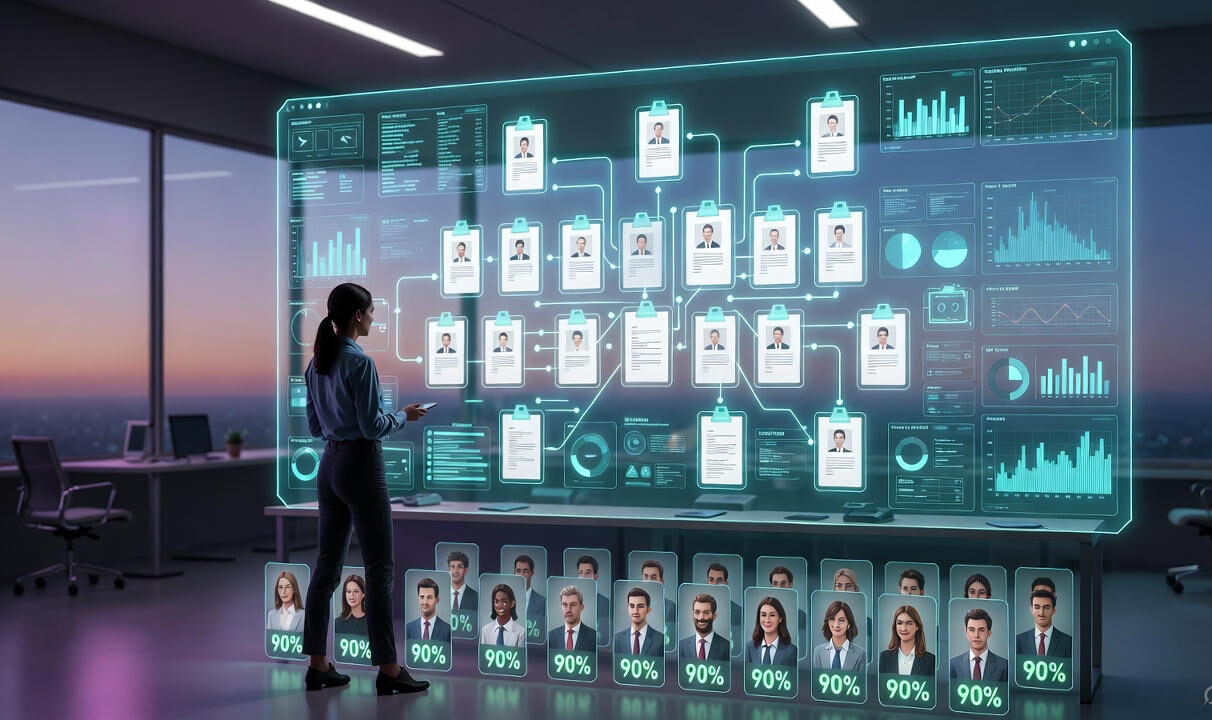
AI in the staffing industry is fundamentally changing how companies find, evaluate, and manage talent. From automated resume screening to predictive workforce planning, artificial intelligence is making recruitment faster, more accurate, and increasingly data-driven. This comprehensive guide explores how AI works in staffing, what benefits it brings, where it falls short, and how your organization can implement it responsibly.
Whether you’re an HR leader at a growing company, a staffing professional managing high-volume hiring, or a business owner trying to build the right team, understanding AI’s role in recruitment isn’t optional anymore it’s essential.
Let me walk you through everything you need to know.
What AI in Staffing Actually Means
At its core, AI in the staffing industry refers to using artificial intelligence technologies to automate, enhance, or support recruitment and workforce management tasks. Instead of manually reading hundreds of resumes or guessing which candidates might succeed, you’re using software that learns patterns from data and makes increasingly accurate predictions.
The Key Technologies Behind AI Staffing
Natural Language Processing (NLP)
This technology helps computers understand human language. In staffing, NLP powers resume parsing the ability to read a resume and automatically extract information like job titles, skills, education, and work history. It also enables chatbots to have natural conversations with candidates and helps analyze interview transcripts for sentiment and key phrases.
Machine Learning
Machine learning algorithms improve through experience. When you feed them historical hiring data who you hired, who succeeded, who left quickly they identify patterns you might miss. Over time, these systems get better at predicting which candidates will likely perform well or which employees might leave soon.
Predictive Analytics
This uses statistical techniques and machine learning to forecast future outcomes. In staffing, predictive analytics can estimate how long it takes to fill a role, predict which candidates will accept offers, identify flight risks among current employees, or forecast future headcount needs based on business growth patterns.
Computer Vision and Video Analysis
Some AI tools analyze video interviews, looking at facial expressions, tone of voice, and word choice to assess candidate fit. While this technology is advancing, it also raises significant ethical questions we’ll explore later.
Together, these technologies create AI recruitment tools that can handle tasks ranging from simple automation (scheduling interviews) to complex decision support (predicting which candidate has the highest likelihood of success).
AI for Resume Parsing and Candidate Screening
Let’s start with the most common application: using AI for resume screening.
The Traditional Problem
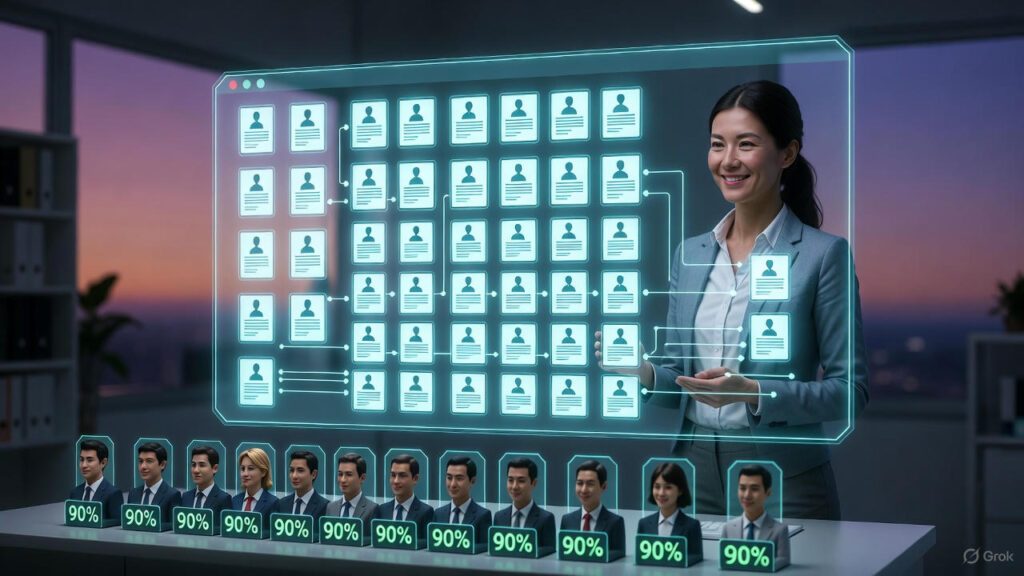
Imagine posting a job opening and receiving 500 applications in three days. A recruiter might spend 30 seconds scanning each resume, which means 4+ hours just for the initial screen. Multiply that by dozens of open positions, and you see why recruiting teams feel overwhelmed.
Moreover, human screening is inconsistent. One recruiter might prioritize skills; another focuses on experience. Unconscious bias creeps in research shows that identical resumes with different names receive different callback rates based on perceived gender or ethnicity.
How AI Resume Screening Works
AI-powered resume screening tools use NLP to automatically read and categorize resumes. Here’s what happens:
- Parsing: The system extracts structured data from unstructured resumes (PDF, Word documents, plain text). It identifies sections, pulls out names, contact details, work experience, education, skills, and certifications.
- Scoring: Based on the job requirements you’ve defined, the AI assigns each candidate a relevance score. If you need “five years of Python experience,” the algorithm identifies candidates meeting that criterion.
- Ranking: Candidates are ranked from most to least qualified, letting recruiters focus on the top 10-20% immediately.
- Knock-out questions: The system can automatically reject candidates who don’t meet mandatory requirements (like “must have valid nursing license”).
Real-World Impact
A mid-sized tech company I know implemented AI resume screening for their engineering roles. Previously, their three-person recruiting team spent roughly 60% of their time on initial resume review. After implementation, that dropped to 15%. The AI screened 85% of applicants automatically, flagging only the most qualified for human review.
Time-to-fill decreased from 45 days to 28 days. Recruiters could spend more time on candidate engagement, improving their acceptance rate by 12%.
The Catches and Concerns
AI resume screening isn’t perfect. The algorithm only knows what you teach it. If you train it on your past hires and those hires were homogeneous, the AI might perpetuate that pattern. If your successful employees all came from five universities, the system might unfairly favor those schools.
Keywords can be gamed. Candidates who stuff their resumes with job description phrases might rank higher than truly qualified applicants who use different terminology.
The system struggles with non-traditional backgrounds. Career changers, candidates with unconventional experience, or people returning from employment gaps might score poorly even if they’re excellent fits.
That’s why responsible AI use requires human oversight, regular audits for bias, and clear criteria that align with actual job performance not just credential checklists.
AI-Driven Candidate Matching and Talent Pools
Beyond screening individual resumes, AI excels at matching candidates to multiple opportunities and managing talent pools over time.
Candidate Matching Algorithms
Think of this as intelligent matchmaking. Instead of manually searching your applicant tracking system (ATS) for candidates who might fit a new role, AI candidate matching algorithms automatically surface the best fits.
Here’s how it works:
Semantic Understanding: Modern AI doesn’t just match exact keywords. If a job requires “customer success experience” and a candidate lists “client relationship management,” the algorithm recognizes these as related concepts.
Multi-dimensional Scoring: The system considers dozens of factors simultaneously skills match, experience level, location preferences, salary expectations, career trajectory, and even soft indicators like engagement with your employer brand.
Learning from Outcomes: When you hire candidates the AI recommended, it learns those were good matches. When hires don’t work out, it adjusts its criteria. Over time, the system gets smarter about what success looks like for your specific organization.
Building and Activating Talent Pools
AI transforms how you manage candidate databases. Instead of letting promising candidates disappear after one rejection, AI keeps them engaged and surfaces them for future opportunities.
A healthcare staffing firm I’m familiar with uses AI to maintain pools of nursing candidates across different specialties. When a hospital client needs ICU nurses with trauma experience, the AI instantly identifies candidates who match those criteria from previous interactions, even if they applied months ago for different roles.
The system also predicts when passive candidates might be open to new opportunities based on tenure at current employers, industry trends, and engagement patterns with recruiting communications.
Diversity and Inclusion Benefits
When implemented thoughtfully, AI candidate matching can reduce bias. By focusing on skills and experience rather than demographics, and by presenting diverse candidate slates to hiring managers, AI can support more equitable hiring.
However, this only works if you actively design for it. You need to:
- Remove identifying information that could trigger bias
- Regularly audit matching results for demographic disparities
- Ensure your training data doesn’t encode historical bias
- Set explicit diversity goals the system helps you track
AI in Interviews and Assessments
AI is increasingly present in the interview and assessment phase, though this is where ethical concerns are most pronounced.
AI-Powered Interview Scheduling
Let’s start with the uncontroversial: AI makes scheduling easier. Instead of endless email chains finding a mutually available time, AI scheduling tools integrate with calendars, check availability, and automatically book interviews. Some chatbots even handle candidate questions about the process.
This might sound trivial, but for high-volume hiring, it saves substantial coordinator time and improves candidate experience by reducing response delays.
Video Interview Analysis
This is more complex and controversial. Some platforms analyze video interviews, using computer vision and NLP to assess:
- Word choice and language patterns
- Facial expressions and emotional signals
- Voice tone and speech characteristics
- Answers to specific questions compared to successful employees
Proponents argue this adds objectivity and catches signals humans might miss. Critics worry about algorithmic bias, privacy violations, and the questionable science behind some emotion-detection claims.
Several organizations have already restricted or banned AI video interview analysis due to bias concerns. The European Union’s AI Act classifies some emotion recognition systems as high-risk, requiring strict oversight.
Skills Assessments and Gamification
AI-driven assessments test candidates through simulations, coding challenges, or game-like scenarios. The AI evaluates performance in real-time, providing immediate scores and insights.
For technical roles, this works well. A coding assessment objectively measures whether someone can write functional code. For roles requiring judgment or creativity, it’s trickier AI struggles to evaluate nuance.
The Human Element in AI-Assisted Interviews
The most effective approach combines AI insights with human judgment. AI might flag that a candidate’s answers lack detail compared to top performers, prompting the interviewer to probe deeper. But the final assessment should come from experienced interviewers who can evaluate context, potential, and culture fit things AI can’t reliably measure.
Predictive Analytics for Quality of Hire and Retention
This is where AI in the staffing industry gets really powerful: predicting outcomes before they happen.
Predicting Quality of Hire
Quality of hire is notoriously difficult to measure. It combines performance ratings, ramp-up time, cultural fit, and long-term contribution. AI predictive hiring models analyze patterns in your best performers and identify which candidate attributes correlate with success.
For example, an AI system might discover that for your sales team, prior experience in consultative selling predicts performance better than total years of sales experience. Or it might find that candidates who ask specific types of questions during interviews tend to become high performers.
You can then prioritize candidates with those attributes, improving your hiring success rate.
Retention Prediction and Flight Risk
AI analyzes employee data to identify flight risk the probability someone will leave soon. Warning signs might include:
- Declining engagement scores
- Reduced collaboration patterns (measured through communication tools)
- Tenure at career transition points
- Compensation below market rate
- Manager changes or team restructuring
When the AI flags an employee as high flight risk, managers can proactively address concerns through conversations, development opportunities, or compensation adjustments.
A large retailer used retention prediction AI to reduce store manager turnover by 18%. By identifying at-risk managers early and implementing targeted retention efforts, they saved millions in replacement costs.
Performance Prediction Models
Some advanced systems predict how a candidate will perform if hired. By analyzing the candidate’s background against performance data of similar past hires, the AI estimates likely outcomes.
This sounds almost too good to be true, and honestly, it often is. Performance prediction is highly contextual someone excellent in one environment might struggle in another due to factors AI can’t capture (team dynamics, manager effectiveness, company culture shifts).
Use performance predictions as one input, not a definitive answer. They’re most reliable when you have substantial historical data and relatively stable role requirements.
AI-Powered Workforce Planning and Headcount Forecasting
Beyond filling individual roles, AI helps organizations plan their workforce strategically.
Forecasting Future Headcount Needs
Workforce planning traditionally involves educated guesses about future hiring needs based on business plans and growth projections. AI makes this more scientific.
By analyzing historical data revenue growth, seasonal patterns, project pipelines, employee turnover, and market conditions AI can forecast how many people you’ll need in which roles and when.
A manufacturing company used AI workforce planning to predict they’d need 15% more production staff by Q3 to meet forecasted orders. They started recruiting in Q1, avoiding the scramble competitors faced when orders surged.
Skills Gap Analysis
AI can map your current workforce’s skills against future needs, identifying gaps before they become critical. If your business is shifting toward cloud computing, the AI might flag that only 12% of your IT staff have cloud certifications, highlighting a training or hiring need.
For a deeper dive into how staffing teams structure long-term hiring programs, you can review independent workforce planning resources published by experienced staffing consultants.
Internal Talent Marketplaces
Progressive companies use AI to match internal employees to new opportunities. Instead of always hiring externally, the AI identifies existing employees whose skills and interests align with open positions.
This improves retention (employees see career growth opportunities), reduces hiring costs, and shortens time-to-productivity since internal candidates already know your culture and processes.
Scenario Planning
AI workforce planning tools let you model “what if” scenarios:
- What if we grow revenue 20% next year?
- What if turnover increases by 10%?
- What if we open a new market?
- What if minimum wage increases?
The system calculates the workforce implications of each scenario, helping leadership make informed strategic decisions.
Benefits and Limitations of AI in Staffing
Let’s be clear-eyed about what AI delivers and where it falls short.
The Real Benefits
1. Efficiency and Speed
AI for resume screening processes hundreds of applications in minutes. Chatbots answer candidate questions 24/7. Automated scheduling eliminates coordination delays. For high-volume hiring, these time savings are transformative.
2. Data-Driven Decisions
Instead of relying on gut feelings, you base decisions on patterns in your actual hiring outcomes. This leads to more consistent, defensible choices.
3. Improved Candidate Experience
Fast responses, clear communication, and streamlined processes create better experiences for candidates. AI enables personalization at scale customized job recommendations, tailored communication, and relevant opportunities.
4. Reduced Bias (When Done Right)
AI can ignore demographic information and focus purely on job-relevant criteria. This requires intentional design and ongoing monitoring, but it’s possible to reduce human bias through careful AI implementation.
5. Better Resource Allocation
When AI handles routine tasks, recruiters focus on relationship-building, strategic sourcing, and complex evaluations where human judgment is irreplaceable.
The Limitations and Risks
1. Algorithmic Bias
If your training data reflects historical bias, AI perpetuates it. Amazon famously scrapped an AI recruiting tool that discriminated against women because it learned from a male-dominated hiring history.
Regular audits for disparate impact are essential. You need to check whether AI recommendations affect different demographic groups differently and adjust accordingly.
2. Lack of Transparency
Many AI systems are “black boxes” you see the recommendation but can’t understand why. This creates legal risk (hard to defend a decision you can’t explain) and practical problems (can’t improve what you don’t understand).
Look for explainable AI tools that show which factors influenced recommendations.
3. Data Privacy and Security
AI requires substantial candidate and employee data. You must comply with regulations like GDPR, ensure data security, and be transparent about how you use information.
4. Over-Reliance on Technology
AI excels at pattern recognition but struggles with exceptions. The brilliant candidate with an unconventional background might be filtered out. The technically qualified candidate who’s a culture nightmare might be recommended.
Never let AI make final decisions without human review.
5. Implementation Complexity
Effective AI requires clean, comprehensive data. Many organizations discover their ATS data is incomplete, inconsistent, or poorly structured. Significant data cleanup may be needed before AI delivers value.
6. Legal and Compliance Concerns
Employment law is catching up to AI. The EEOC is scrutinizing AI hiring tools for discrimination. New York City requires bias audits for automated employment decision tools. Illinois regulates AI video interview analysis.
You need legal counsel familiar with AI employment law to navigate this evolving landscape.
Human-in-the-Loop: Why Recruiters Still Matter
Despite AI advances, humans remain irreplaceable in staffing. Here’s why.
What Humans Do Better
Contextual Understanding
AI sees data points; humans understand context. When a candidate has a six-month gap on their resume, AI might flag it negatively. A human recruiter learns the candidate was caring for a sick parent or pursuing relevant education context that completely changes the evaluation.
Relationship Building
Recruiting is fundamentally about relationships. Understanding a candidate’s motivations, building trust, negotiating offers, and maintaining long-term networks require emotional intelligence AI doesn’t possess.
Judgment and Intuition
Sometimes a candidate just feels right or wrong for reasons you can’t articulate. Experienced recruiters develop intuition from thousands of interactions. This gut feel, combined with data, often produces the best outcomes.
Ethical Oversight
Humans must make ethical judgments about AI use. When should you override an AI recommendation? How do you balance efficiency with fairness? These are human decisions.
Adaptability
When market conditions shift, hiring priorities change, or new roles emerge, humans adapt quickly. AI requires retraining and adjustment.
The Optimal Model: Augmented Intelligence
The future isn’t AI replacing recruiters it’s AI augmenting them. Think of it as enhanced decision-making:
- AI handles high-volume screening; humans evaluate top candidates deeply
- AI suggests matches; humans assess fit and potential
- AI tracks metrics; humans interpret trends and adjust strategy
- AI automates scheduling; humans conduct meaningful interviews
- AI identifies flight risk; humans have retention conversations
This augmented approach delivers the efficiency of automation with the judgment and humanity of skilled professionals.
Step-by-Step Roadmap for Implementing AI in Recruitment
Ready to start using AI in your staffing function? Here’s a practical implementation roadmap.
Step 1: Assess Your Current State
Before adding AI, understand your baseline:
- What are your biggest recruiting pain points?
- Where do you spend the most time?
- What metrics matter most (time-to-fill, quality of hire, cost per hire)?
- What data do you currently collect?
- What’s your technology stack (ATS, HRIS, etc.)?
Don’t implement AI just because it’s trendy. Implement it to solve specific, measurable problems.
Step 2: Identify the Right Use Case
Start with one clear application where AI can drive significant impact:
For high-volume hiring: Begin with AI resume screening to handle hundreds of applications efficiently.
For specialized roles: Try AI candidate matching to surface qualified candidates from your existing talent pool.
For retention issues: Implement predictive analytics to identify and address flight risk.
For workforce planning: Use AI forecasting if you’re growing rapidly and need to scale hiring strategically.
Choose based on your biggest pain point and where you have adequate data.
Step 3: Evaluate AI Recruitment Tools
When assessing vendors, ask:
- Does this integrate with our existing ATS and HRIS?
- What data is required, and do we have it?
- Can we see how the AI makes decisions (explainability)?
- Have they conducted bias audits?
- What’s their approach to data privacy and security?
- Can we customize criteria for our specific needs?
- What does implementation look like (timeline, resources)?
- What ongoing support do they provide?
Request demos with your actual data (anonymized if necessary) to see real performance.
Step 4: Prepare Your Data
Clean, comprehensive data is essential. You’ll likely need to:
- Standardize job titles and levels
- Ensure consistent skill tagging
- Complete missing fields in candidate records
- Link hiring data to performance data
- Document outcomes (who was hired, who succeeded, who left)
This isn’t glamorous work, but it’s critical. Garbage in, garbage out applies doubly to AI.
Step 5: Pilot with a Limited Scope
Don’t roll out AI company-wide immediately. Start with:
- One department or job family
- A limited time period (e.g., three months)
- Clear success metrics defined upfront
- Parallel processes (human and AI) to compare results
Monitor closely: Is AI saving time? Are recommendations accurate? Are there unexpected biases? Gather feedback from recruiters and candidates.
Step 6: Train Your Team
Your recruiting team needs to understand:
- How the AI works (at least conceptually)
- How to interpret AI recommendations
- When to override AI decisions
- How to give feedback to improve the system
- Legal and ethical considerations
AI is a tool, not a replacement. Recruiters should feel empowered to use their judgment.
Step 7: Monitor, Audit, and Iterate
AI implementation is never “done.” Establish ongoing processes to:
- Track key metrics (time-to-fill, quality of hire, candidate satisfaction)
- Audit for bias regularly (analyze outcomes by demographic groups)
- Collect feedback from recruiters and candidates
- Retrain models as your organization and workforce evolve
- Stay current on legal and regulatory developments
Plan for continuous improvement. What works today may need adjustment tomorrow.
Step 8: Expand Thoughtfully
Once your pilot succeeds, expand gradually:
- Add more roles or departments
- Introduce additional AI capabilities
- Integrate AI more deeply into your workflow
- Scale successful practices across the organization
Rushing expansion risks replicating early mistakes at scale. Grow deliberately based on validated success.
Future Trends: Where AI Staffing is Heading
The AI capabilities available today are just the beginning. Here’s what’s coming.
Generative AI for Job Descriptions and Outreach
Generative AI models like GPT-4 are already being used to draft job descriptions, personalize candidate outreach, and write recruiting emails. Soon, AI will automatically generate customized content for every candidate based on their background and interests.
Imagine an AI that reviews a candidate’s LinkedIn profile and work history, then writes a personalized message explaining why your open role aligns with their career goals individually tailored to hundreds of candidates.
Skills-Based Hiring
The shift from credentials (degrees, job titles) to demonstrable skills is accelerating. AI makes skills-based hiring practical by:
- Extracting skills from unstructured resumes and profiles
- Assessing skills through simulations and assessments
- Matching candidates to roles based on skill overlap, not job title similarity
- Identifying transferable skills from different industries
This opens opportunities for non-traditional candidates and focuses on what people can actually do.
Internal Talent Marketplaces and Career Pathing
AI-powered internal talent marketplaces will become standard. Employees browse internal opportunities, and AI recommends roles matching their skills and career interests. The system might suggest: “Based on your experience and stated interests, you’d be a strong fit for these three roles opening next quarter.”
This keeps talent engaged and visible, reducing turnover and improving internal mobility.
Real-Time Workforce Intelligence
Dashboards will provide real-time visibility into workforce trends:
- Who’s at flight risk this month?
- Which skills are we short on?
- How are hiring metrics trending?
- What’s our projected headcount in six months given current trends?
Leaders will make decisions with live data rather than quarterly reports.
Ethical AI and Explainable Algorithms
As concerns about AI bias and transparency grow, we’ll see more regulation and better tools. Expect:
- Mandatory bias audits becoming standard
- More explainable AI that shows its reasoning
- Industry standards for responsible AI use
- Greater candidate rights to understand and contest AI decisions
Organizations leading in ethical AI will have a competitive advantage in attracting top talent who value fairness and transparency.
Frequently Asked Questions
Is AI replacing recruiters?
No. AI in the staffing industry is augmenting recruiters, not replacing them. While AI handles time-consuming tasks like resume screening and interview scheduling, humans remain essential for relationship building, contextual judgment, ethical oversight, and strategic decision-making. The most effective recruitment teams combine AI efficiency with human expertise. Think of AI as a powerful assistant that frees recruiters to focus on high-value activities like candidate engagement and strategic sourcing.
How do I start using AI in hiring?
Start by identifying your biggest recruiting pain point whether it’s high-volume screening, slow time-to-fill, or poor quality of hire. Choose one AI application to pilot (like resume screening for a specific role type), ensure your data is clean and structured, select a vendor whose tools integrate with your existing systems, and test with a limited scope before expanding. Success requires clear metrics, team training, and commitment to monitoring results. Don’t try to implement everything at once; focused pilots with measurable outcomes build confidence and learning.
Is AI resume screening fair for candidates?
AI resume screening can be fairer than human screening when implemented responsibly, as it can ignore demographic information and focus purely on job-relevant criteria. However, if AI is trained on biased historical data, it perpetuates that bias. To ensure fairness, organizations must regularly audit AI tools for disparate impact across demographic groups, use transparent criteria aligned with actual job performance, provide human oversight of AI decisions, and comply with emerging regulations. Responsible AI hiring requires ongoing vigilance, not just initial setup.
What data do I need for AI-powered workforce planning?
Effective AI workforce planning requires historical hiring data (time-to-fill, source of hire, costs), employee data (skills, performance ratings, tenure, promotions, departures), business metrics (revenue, projects, seasonal patterns), and market information (labor market trends, competitor activity). The data should span at least 2-3 years for reliable pattern recognition. Critically, the data must be clean, consistent, and properly structured. Many organizations discover their data requires significant cleanup before AI can deliver value. Start by auditing your current data quality and addressing gaps.
What are the legal risks of using AI in recruitment?
AI hiring tools face increasing legal scrutiny. Key risks include discrimination if AI produces disparate impact on protected groups, even unintentionally; violation of data privacy laws like GDPR if you don’t handle candidate data properly; and non-compliance with emerging AI-specific regulations like New York City’s bias audit requirements for automated employment decision tools. To mitigate risks, conduct regular bias audits, maintain human oversight of AI decisions, document your AI decision-making process, ensure legal counsel reviews your AI implementation, and stay current on evolving employment law. The regulatory landscape is rapidly changing, so compliance requires ongoing attention.
Conclusion: Moving Forward with AI in Staffing
AI in the staffing industry isn’t a passing trend it’s a fundamental shift in how recruiting and workforce planning work. Organizations that embrace AI thoughtfully will hire faster, make better decisions, and plan their workforce more strategically. Those that ignore it will fall behind competitors who can operate more efficiently.
But success requires more than just adopting technology. You need:
- Clear objectives tied to business outcomes
- Clean, comprehensive data
- Responsible implementation with ongoing bias monitoring
- Human oversight and ethical guardrails
- Continuous learning and adaptation
Start small. Pick one high-impact use case whether that’s AI for resume screening, predictive retention analytics, or workforce planning and implement it carefully. Learn from that pilot. Measure results. Adjust and expand.
The future of staffing combines the efficiency and pattern recognition of AI with the judgment, relationships, and ethical reasoning of skilled humans. That future is already here for organizations ready to embrace it.
The question isn’t whether AI will transform your recruiting function. The question is whether you’ll lead that transformation or be forced to catch up later. The choice is yours.